Hi everyone!
I’d like to share AdaMic — Adaptive Microbial Cultivation, a project I’ve been working on since the beginning of 2026. My aim is to extend Pioreactor with additional electrochemical sensors and use the resulting multimodal data to investigate suitable cultivation conditions for fastidious bacterial strains. The sensing platform is a step towards adaptive cultivation and experimentation.
I initially worked with Chi.Bio, then moved to Pioreactor because its extensibility and active community were a better fit for this project. I’ll use this thread to share new plugins, hardware designs, and lessons learned as the setup develops.
Current setup
Like several other members of this community, I’m using Atlas Scientific EZO circuits and probes. The pH measurement setup is the most developed part so far. Rather than placing the electrodes directly inside the culture vial, I use an external flow cell connected to a recirculation loop.
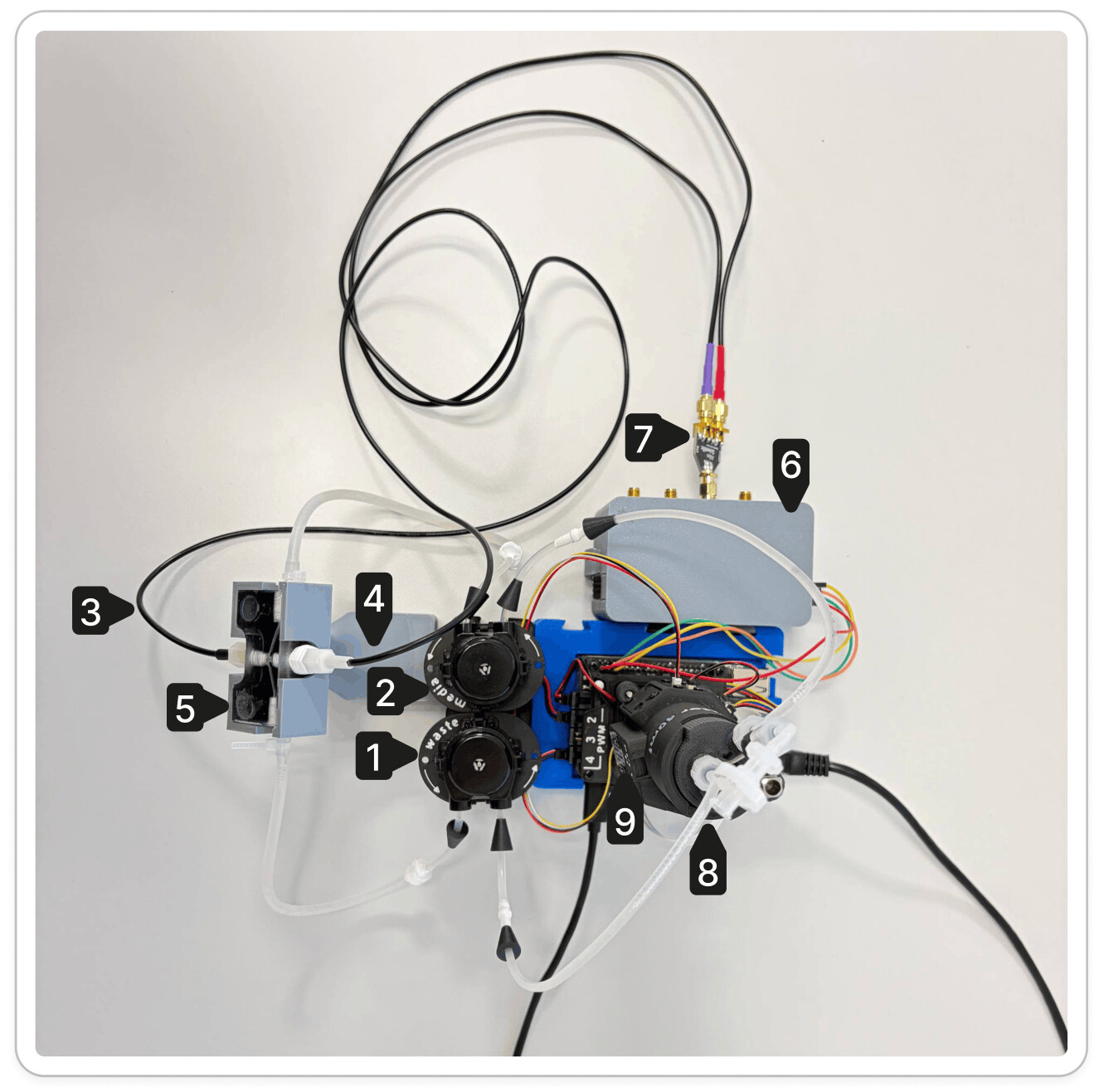
The numbers below refer to the photograph.
1–2. Recirculation pumps
Two Pioreactor peristaltic pumps run continuously to circulate liquid between the vial and the flow cell. I created a plugin for this “flow-cell” operating mode.
The plugin starts and stops both recirculation pumps from a single Flow cell activity. A shared Flow speed control adjusts their PWM duty cycle while running; it also supports pause/resume and an optional runtime limit. It uses the active pump calibrations and does not add dosing events, so recirculation leaves the displayed vial volume unchanged.
3–4. Micro-pH electrodes
The Atlas Scientific micro-pH probe consists of separate working and reference electrodes. Their small size makes them convenient for the external flow cell.
We have also encountered maintenance challenges with these probes. I’ll describe those experiences in a follow-up reply, rather than treating the current setup as a finished solution.
- Hardware: Atlas Scientific Micro pH Probe
5. Flow cell and custom enclosure
The Atlas Scientific flow cell sits in a custom enclosure that uses the same locking interface as the Pioreactor stand. This lets it attach directly to the setup and keeps the sensing assembly together.
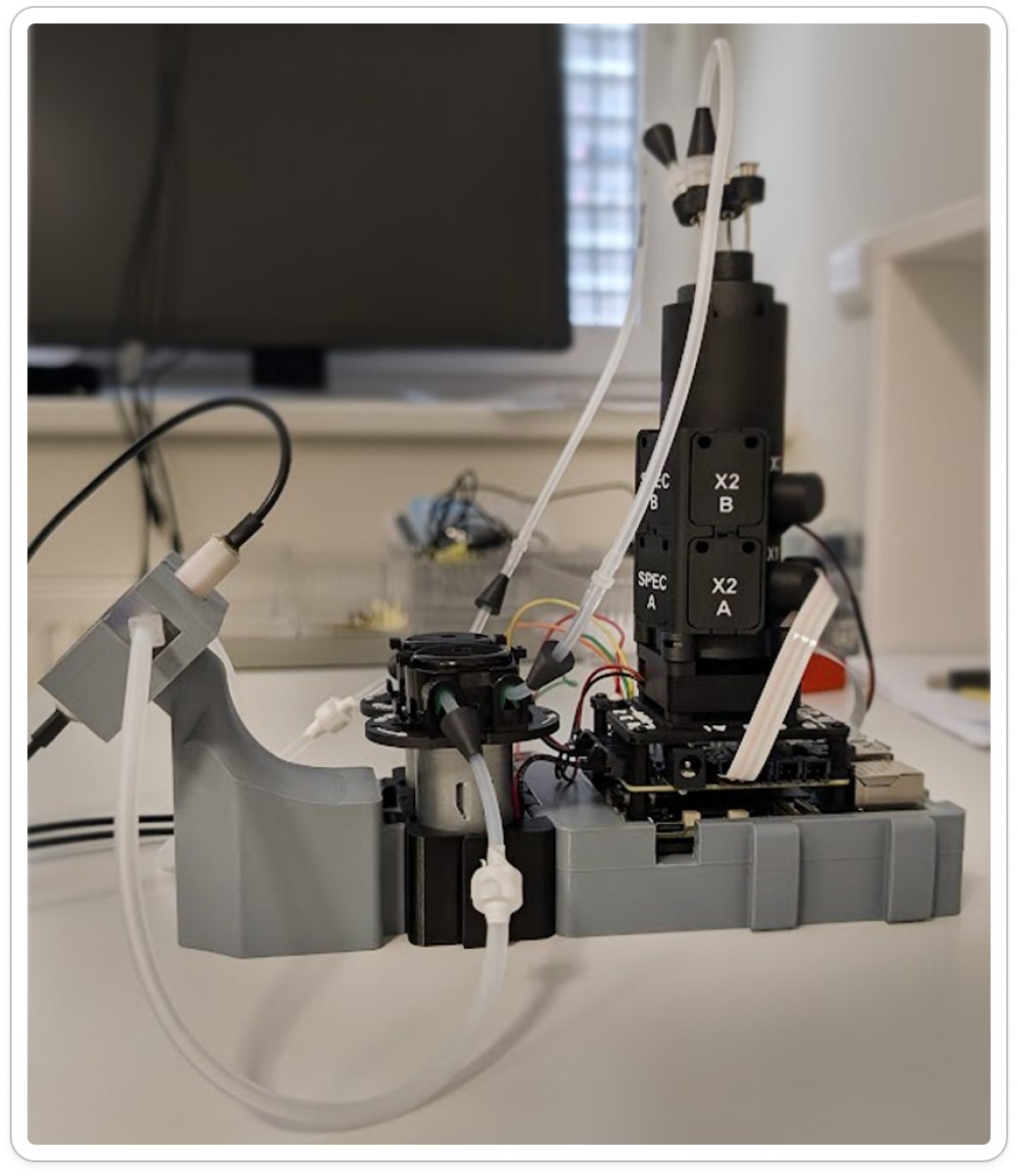
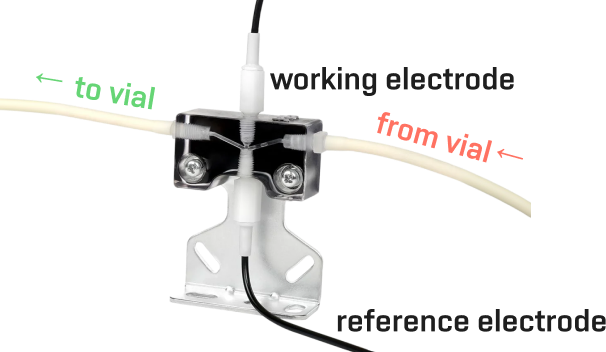
In the close-up, liquid enters from the vial on the right and returns to the vial on the left. The working electrode is above the flow cell and the reference electrode is below it.
- Commercial part: Atlas Scientific Micro pH Flow Cell
- Flow-cell enclosure models and README — stand and cover STL files are available.
6. i4 InterLink and EZO circuits
The Atlas Scientific i4 InterLink connects the EZO circuits to the system. I’ve designed an enclosure for it with the same Pioreactor-compatible locking interface.
I have developed and tested plugins for pH and dissolved oxygen (DO). The ORP plugin is still being refined and will be shared in a later update.
- Hardware: i4 InterLink, EZO-pH circuit, and EZO-DO circuit
- i4 InterLink enclosure models and README
- pH acquisition and calibration plugin
- DO acquisition and calibration plugin
pH plugin: Continuous pH readings appear in an Overview graph and can be exported as CSV through Export data. The guided protocol supports two-point calibration (pH 7 and 4), with an optional third point at pH 10. During calibration, Take reading displays a pH-versus-time chart to help assess stabilization; the completed calibration is recorded in Pioreactor.
DO plugin: Continuous dissolved-oxygen readings in mg/L appear in an Overview graph and can be exported as CSV through Export data. The guided protocol supports calibration in air and an optional zero-oxygen point. Calibration is stored on the EZO-DO circuit, with a record saved in Pioreactor for traceability and export.
For assembly, see the enclosure drawing and i4 InterLink-to-Pioreactor wiring diagram. The folder also contains the editable Fusion enclosure model.
7. SMA half-cell adapter
An SMA half-cell adapter connects the separate micro-pH working and reference electrodes to the measurement circuit.
- Hardware: Atlas Scientific SMA Half-Cell Adapter
8. Vial cap and tubing
The recirculation loop connects to the culture vial through a Pioreactor cap with Luer-lock ports and pump tubing.
9. MLX90632 infrared temperature sensor
In our validation experiments with E. coli, the target temperature was 37 °C. The external loop introduces an additional path for heat loss, so temperature control became an important part of the setup.
In the reference run, using the built-in temperature estimator, the recorded temperature remained around 31–33 °C despite a 37 °C setpoint. With the MLX90632 sensor and the precision-temperature plugin, the recorded temperature reached and stayed close to 37 °C while the flow cell was operating.
These are observations from our particular setup and runs. They are not a general temperature limit for Pioreactor or proof of the sensor’s absolute accuracy. Higher-temperature cultivation is an interesting direction to explore, but we have not established suitability for thermophilic organisms here.
- Hardware: Pioreactor Precision Temperature Sensor
- Installation instructions
- Precision-temperature plugin — developed by Pioreactor, not by me.
Models and next steps
I’ve organized the assembly documentation and model files in a Google Drive folder. Each assembly section has a README with commercial-part links. The flow-cell stand and cover STL files and editable InterLink enclosure model.
Next, I’ll share more about probe maintenance, develop the ORP and conductivity integrations, and continue working towards adaptive cultivation experiments.
I’d be interested to hear from anyone using a similar recirculation setup, particularly about long-term micro-pH probe maintenance and practical improvements to the flow-cell arrangement.
Ing. Borys Aleksandrenko
ORCID: 0009-0007-6446-441X
Email: 240481@vutbr.cz · barabarabaris@gmail.com
This post documents ongoing development of the AdaMic platform and shares hardware and software resources with the community. The work is intended for a future research publication; observations presented here are preliminary and have not undergone peer review.
